Start typing to search every page on this site.

Use ↑ and ↓ to move through results, then Enter to open one.

    Skip to main content

    Midterm 3 Practice Worksheet 4: Solutions#

    These are the solutions to Practice Worksheet 4. The write-ups model the amount of explanation expected on the exam.

    Colorings of a flag#
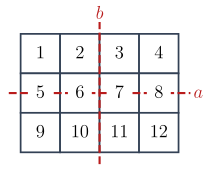
    A rectangle of square cells in 3 rows and 4 columns, numbered 1 to 4 in the top row, 5 to 8 in the middle row, and 9 to 12 in the bottom row, from left to right. A dashed horizontal line labeled a runs through the middle row, and a dashed vertical line labeled b runs between the second and the third column.
    Figure 1: The cells of the flag, with the mirror lines of the reflections and .#

    (A) For each symmetry, is the cell where cell ends up.

    • The half turn sends each cell to the cell symmetric through the center: . No cell lies at the center.

    • The reflection exchanges the top and bottom rows and keeps each cell of the middle row in place: .

    • The reflection exchanges columns and in each row: . No cell lies on its mirror line.

    ElementCycle type

    (B) A coloring is fixed by exactly when it has one color on each cycle of , so : For : a coloring is fixed by when every cell has the same color as its mirror image, so cells and have the same color, and so do and , and , and . The cells of the middle row lie on the mirror line and can have any colors. That is choices for the four pairs and for the middle row: colorings.

    (C) By Burnside’s lemma,

    (D) With colors, For this is , and for it gives again.

    Colorings of a longer flag#

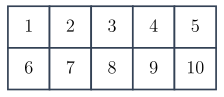
    A rectangle of square cells in 2 rows and 5 columns. The top row has cells 1 to 5 and the bottom row has cells 6 to 10, from left to right.
    Figure 2: The cells of the flag.#

    (A) For each symmetry, is the cell where cell ends up.

    • : each cell goes to the cell symmetric through the center, and no cell lies at the center.

    • : the two rows are exchanged.

    • : the columns are exchanged in pairs, and the cells and of the middle column stay in place.

    ElementCycle type

    (B) : A coloring fixed by gives each cell the same color as its mirror image: cells and have the same color, and so do and , and , and . The cells and lie on the mirror line and can have any colors. That is choices for the four pairs and for the two middle cells, in all.

    (C) By Burnside’s lemma,

    Necklaces and bracelets#
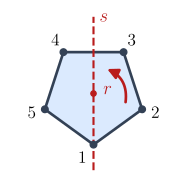
    A regular pentagon with corner 1 at the bottom and the other corners counterclockwise: 2 at the lower right, 3 at the upper right, 4 at the upper left, and 5 at the lower left. A dashed vertical mirror line labeled s passes through corner 1 and the center, and a counterclockwise arrow labeled r turns about the center.
    Figure 3: The labeled pentagon, the rotation , and the mirror line of .#

    (A) The group is . The identity has cycles and fixes colorings. Each of is a single -cycle (for example ), so and it fixes only the one-color colorings.

    (B) The group is , with elements. Each of the reflections fixes the corner on its axis and exchanges the other four corners in two pairs; for example . So , and each reflection fixes colorings.

    (C) Every rotation is also an element of , so two colorings in the same necklace are also in the same bracelet. Each bracelet is therefore a union of necklaces, and there are at most as many bracelets as necklaces.

    Colorings of a square grid#

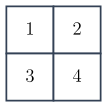
    A 2 by 2 grid with cells 1 and 2 in the top row and cells 3 and 4 in the bottom row, from left to right.
    Figure 4: The cells of the grid.#

    (A) The quarter turn counterclockwise carries the top left cell to the bottom left, and so on: . Then and .

    KindHow manyFixed coloringsProduct
    identity
    quarter turns
    half turn
    Sum––

    So there are colorings up to rotation.

    (B) The reflections are (vertical midline), (horizontal midline), (diagonal through cells and ), and (diagonal through cells and ). The midline reflections have cycles; the diagonal reflections fix the two cells on the diagonal and have cycles.

    Colorings of solids#

    (A) The rotations of the tetrahedron on the vertices: the identity ( cycles), vertex–face rotations ( cycles each), and edge–edge rotations ( cycles each).

    (B) The rotations of the cube on the faces: identity ( cycles); face rotations by or ( cycles); face rotations by ( cycles); vertex rotations ( cycles); edge rotations ( cycles).

    (C) On the vertices: identity ( cycles); face rotations ( cycles); face rotations ( cycles); vertex rotations ( cycles, counting the two fixed vertices on the axis); edge rotations ( cycles).

    (D) The rotations of the prism on the faces: identity ( cycles); turns about the vertical axis ( cycles: two fixed triangles and a -cycle of squares); half turns ( cycles: the triangles exchanged, one square fixed, two squares exchanged).

    Strings up to reversal#

    (A) The group is , where reverses the string. On the positions , has cycles; the fixed strings are the palindromes, of them. The identity fixes all strings. So there are strings up to reversal.

    (B) On positions , has cycles, so there are bit strings up to reversal.