Midterm 3 Practice Worksheet 1: Solutions#
These are the solutions to
Practice Worksheet 1. The
write-ups model the amount of explanation expected on the exam. Permutations
are composed from right to left:
True or false#
(A) True.
(B) False.
(C) True.
(D) True. The cycles
(E) False. By Lagrange’s theorem the number of elements of a subgroup
divides
(F) False.
(G) True. The cycles are disjoint, so the order is
Groups and subgroups#
(A) The multiples of
(B) A finite subset is a subgroup exactly when it is closed under addition.
: subgroup; , , . : subgroup; . : not a subgroup; is not in the set. : subgroup; , , . : not a subgroup; is not in the set. (Also, divides , so size alone does not rule it out; closure does.)
(C) Apply the right factor first. For
The elements of
(D) By Lagrange’s theorem the number of elements of a subgroup divides
(E)
(F) For disjoint cycles, take the least common multiple of the
lengths:
The cycles of
Working with a permutation#
(A) Follow each element under
(B) The order is
(C)
(D) Now apply
(E) The written cycles move
Another permutation#
(A) Follow the elements:
(B) The order is
(C)
Cyclic subgroups of
(A) The multiples of
(B) The multiples of
(C) The multiples of
(D) The multiples of
Symmetries of the regular pentagon#
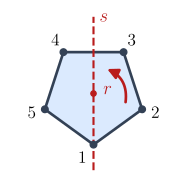
(A) The rotation is
Right to left,
(B)
(C) The identity has order