Midterm 3 Practice Worksheet 3: Rotations of Solids#
This worksheet is optional practice for Midterm 3. It is not collected or graded. Work on paper, as you would on the exam, and write the method that justifies each answer. Then compare with the solutions.
This worksheet covers the rotations of a solid: writing a rotation as a
permutation of the vertices, sorting the rotations by their axes, and checking
the count with the orbit–stabilizer theorem. The labels are different from the
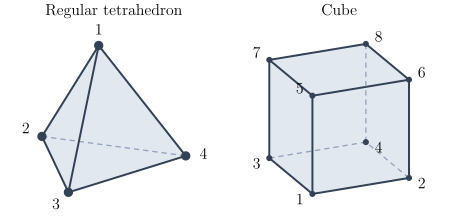
ones in the lecture notes and on the exam; use the labels in the figures.
Permutations are composed from right to left, cycle types list the cycle
lengths, including fixed points, in decreasing order, and
1. (The rotations of the tetrahedron) #
Besides the identity, every rotation of the regular tetrahedron is either a
rotation by
(A) Write in cycle notation, as permutations of thevertices: (i) the rotation byabout the axis through the midpoints of the edges – and – ; (ii) the two rotations about the vertical axis through vertex; (iii) the two rotations about the axis through vertex; (iv) the rotation byabout the axis through the midpoints of the edges – and – ; (v) the two rotations about the axis through vertex.
(B) Complete the table for the action on thevertices. Kind of rotation Axes Rotations Cycle type identity – vertex–face, or edge–edge, Total – – – (C) Findand the orbit of vertex , and check that your total equals . Then do the same for vertex . (D) Complete the same table for the action on theedges. (Write the edge with ends and as .)
2. (The rotations of the cube) #
Besides the identity, every rotation of the cube is a rotation by
(A) Write in cycle notation, as permutations of thevertices: (i) the rotation byabout the vertical axis that sends vertex to vertex ; (ii) the rotation byabout the axis through the midpoints of the edges – and – ; (iii) the rotation byabout the axis through the vertices and that sends vertex to vertex ; (iv) the rotation byabout the axis through the centers of the front face and the back face ; (v) the rotation byabout the axis through the centers of the left face and the right face that sends vertex to vertex ; (vi) the rotation byabout the axis through the midpoints of the edges – and – .
(B) Complete the table for the action on thevertices, and check that the total number of rotations is . Kind of rotation Axes Rotations Cycle type identity – face–face, or face–face, vertex–vertex, or edge–edge, Total – – – (C) Check the total with the orbit–stabilizer theorem twice: once with the orbit and stabilizer of vertex, and once with the orbit and stabilizer of the bottom face. (D) Complete the same table for the action on thefaces.
To count the rotations of one kind, count the axes of that kind and multiply by
the number of nonidentity rotations about each axis. Rotations of the same kind
have the same cycle type, so you only need the cycles of one rotation of each
kind. In this cube, opposite vertices add up to
3. (The rotations of a triangular prism) #
A triangular prism has two equilateral triangles as ends and three squares as
sides. Its top triangle has vertices
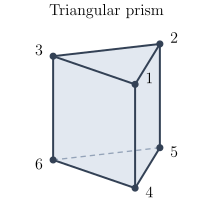
(A) Besides the identity, the rotations of the prism are the rotations byand about the vertical axis through the centers of the two triangles, and the half turns about a horizontal axis through the midpoint of a vertical edge and the center of the opposite square. Write all the rotations in cycle notation, as permutations of the vertices. How many are there? (B) Make a table, as in the previous problems, for the action on thevertices and for the action on the faces. (C) Check the number of rotations with the orbit–stabilizer theorem, using the orbit and stabilizer of the top triangle.