Start typing to search every page on this site.

Use ↑ and ↓ to move through results, then Enter to open one.

    Skip to main content

    Midterm 3 Practice Worksheet 3: Solutions#

    These are the solutions to Practice Worksheet 3. The write-ups model the amount of explanation expected on the exam. The vertex labels are those of the figures on the worksheet: the tetrahedron has top vertex and base ; the cube has bottom face (front left), (front right), (back left), (back right), with above ; the prism has top triangle , with below .
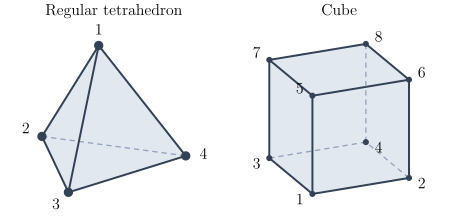
    Left: a regular tetrahedron with vertex 1 on top and base triangle 2, 3, 4; vertex 3 is at the front and the edge from 2 to 4 is hidden. Right: a cube whose bottom face has vertex 1 at the front left, 2 at the front right, 3 at the back left, and 4 at the back right; 5, 6, 7, 8 lie directly above 1, 2, 3, 4. Vertex 4 is hidden at the back.
    Figure 1: Left: a regular tetrahedron with top vertex and base , counterclockwise seen from above. Right: a cube whose bottom face has vertices (front left), (front right), (back left), and (back right); vertex lies directly above vertex . Dashed edges are hidden.#

    The rotations of the tetrahedron#

    (A) (i) The half turn about the axis through the midpoints of – and – exchanges the two ends of each of these edges: (ii) The vertical axis passes through vertex and the center of the base. Turning by counterclockwise (seen from above) moves the base vertices and fixes ; turning by moves them the other way. The two rotations are and .

    (iii) The axis through vertex passes through the center of the opposite face , and the rotations turn that face: and .

    (iv) The half turn exchanges the ends of the edges on its axis: .

    (v) The axis through vertex passes through the center of the opposite face , and the rotations about it are and .

    (B) There is one vertex–face axis through each vertex, so axes, each with nonidentity rotations: rotations, each fixing the vertex on its axis and moving the other three in a -cycle. The edges form pairs of opposite edges ( and , and , and ), so there are edge–edge axes, each with one half turn: rotations, each a product of two -cycles, as in (A)(i).

    Kind of rotationAxesRotationsCycle type
    identity–
    vertex–face, or
    edge–edge,
    Total–––

    (C) The rotations fixing vertex are those about the vertical axis: . Vertex can be sent to every vertex; for example, the half turns , , send it to , , . So the orbit of vertex is , and , which agrees with the table.

    For vertex : the rotations fixing are those about the axis through , so by (A)(v). The half turns , , send to , , , so the orbit of vertex is , and again .

    (D) Take one rotation of each kind. The rotation moves the edges at the top and the base edges : two -cycles. The half turn sends the edges and to themselves (each is flipped end to end, but as an edge it stays in place) and exchanges and : two fixed edges and two -cycles.

    Kind of rotationAxesRotationsCycle type
    identity–
    vertex–face, or
    edge–edge,
    Total–––

    The rotations of the cube#

    (A) (i) Going around the bottom face, the vertices are (front left), (front right), (back right), (back left). The quarter turn that sends to moves each bottom vertex one step along this cycle, and each top vertex follows the vertex below it: (ii) The edge opposite – is – (opposite vertices add up to ). The half turn exchanges the two ends of each of these edges, and . It also exchanges the two faces that meet along the edge –: the bottom face and the front face . Vertex , next to in the bottom face, goes to the vertex next to in the front face, which is ; vertex , next to in the bottom face, goes to , next to in the front face. A half turn has order , so (iii) The vertices and on the axis stay fixed. The three neighbors of vertex are turned among themselves; since , they go . Opposite vertices go to opposite vertices: the vertices opposite are , so . So (iv) The half turn keeps the front face and the back face in place and turns each by , which exchanges opposite corners of each face: (v) Going around the left face, the vertices are (bottom front), (top front), (top back), (bottom back). The quarter turn that sends to moves each of them one step along this cycle, and each vertex of the right face follows its neighbor on the left face ( is next to , to , to , to ): (vi) The edges – and – are opposite (opposite vertices add up to ). The half turn exchanges the ends of each, and , and exchanges the two faces that meet along –: the front face and the left face . Vertex , next to in the front face, goes to the vertex next to in the left face, which is ; vertex , next to in the front face, goes to , next to in the left face. So

    (B) There are face–face axes (the faces form opposite pairs), each with rotations by , , ; vertex–vertex axes (the vertices form opposite pairs), each with nonidentity rotations; and edge–edge axes (the edges form opposite pairs), each with one half turn. The cycle types come from the examples in (A): (i) for , (iv) for about a face axis, (iii) for the vertex axes, and (ii) for the edge axes.

    Kind of rotationAxesRotationsCycle type
    identity–
    face–face, or
    face–face,
    vertex–vertex, or
    edge–edge,
    Total–––

    Indeed .

    (C) A rotation fixing vertex also fixes the opposite vertex , so it is a rotation about the axis through and : has elements (, , ). Vertex can be carried to any of the vertices, and .

    A rotation keeping the bottom face in place is a rotation about the vertical axis: of them. The bottom face can be carried to any of the faces, and .

    (D) Use the same four examples.

    • (i), about the vertical axis: the bottom and top faces stay, and the side faces form the -cycle (front right back left).

    • (iv), about the front–back axis: the front and back faces stay, the bottom and top are exchanged, and the left and right are exchanged.

    • (iii), about the axis through and : the three faces at vertex (bottom, left, front) form a -cycle, and the three faces at vertex (top, right, back) form another.

    • (ii), about an edge axis: the faces are exchanged in three pairs, bottom with front, top with back, and left with right; no face is fixed.

    Kind of rotationAxesRotationsCycle type
    identity–
    face–face, or
    face–face,
    vertex–vertex, or
    edge–edge,
    Total–––

    Notice that the face and edge half turns have the same cycle type on the vertices but different cycle types on the faces.

    The rotations of a triangular prism#
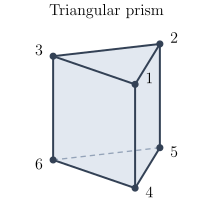
    A triangular prism standing on a triangle. The top triangle has vertices 1 at the front, 2 at the back right, and 3 at the back left; 4, 5, 6 lie directly below 1, 2, 3. The edge from 5 to 6 is hidden.
    Figure 2: A triangular prism with top triangle and bottom triangle ; vertex lies below vertex . Dashed edges are hidden.#

    (A) About the vertical axis: and . For the half turns, take the axis through the midpoint of the vertical edge – and the center of the opposite square . The half turn flips the edge – end to end, so , and turns the square by about its center, which exchanges its opposite corners, and . In the same way for the other two vertical edges: With the identity, there are rotations.

    (B) On the vertices, the turns about the vertical axis have two -cycles, and the half turns have three -cycles. On the faces, a turn about the vertical axis keeps both triangles and moves the three squares in a -cycle; a half turn exchanges the two triangles, keeps the square on its axis in place, and exchanges the other two squares.

    Kind of rotationAxesRotationsType on verticesType on faces
    identity–
    vertical, or
    half turn
    Total–––––

    (C) The top triangle can be kept in place or exchanged with the bottom triangle, so its orbit has elements. The rotations keeping it in place are the rotations about the vertical axis. So the prism has rotations, as in (A).

    On this page