Midterm 3 Practice Worksheet 2: Orbits, Stabilizers, and Fixed Sets#
This worksheet is optional practice for Midterm 3. It is not collected or graded. Work on paper, as you would on the exam, and write the method that justifies each answer. Then compare with the solutions.
This worksheet covers group actions: the true-or-false facts about orbits and
stabilizers, and the computation of orbits, stabilizers, and fixed sets of
colorings. As on the exam, a symmetry
The square. Label the corners of a square
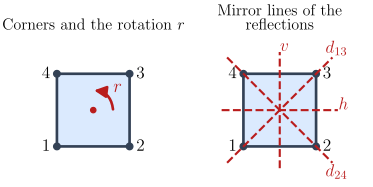
A coloring is written as the string
1. (True or false) #
Decide whether each statement is always true, and give a one-line reason or a
counterexample. In each statement, a finite group
(A) For every, the stabilizer contains , and if , then . (B) For every, the fixed set is a subgroup of . (C) If, an orbit can have elements. (D) If, an orbit can have elements. (E) If, then . (F) Two different orbits can have exactly one element in common.(G) Ifand , then some element of is fixed by every element of . (H) If, then has elements. (I) Whenacts on the corners of the square, all four corners have the same stabilizer. (J) .
2. (Colorings of the square) #
(A) Let. Compute for each of the eight symmetries . Then list the orbit and the stabilizer , and check that . (B) Now use three colors, black (), white ( ), and red ( ). Let . Compute for all eight symmetries, and find and . Explain without computing why the stabilizer must be so small. (C) For black-and-white colorings, list the colorings in, in , and in . Explain how each number of colorings follows from the cycles of , , and . (D) Still with three colors, let. Compute for each of the eight symmetries . Then list and , and check that . (E) For black-and-white colorings, list the colorings inand in . Explain how the numbers of colorings follow from the cycles of and of .
3. (Colorings of the hexagon) #
Label the corners of a regular hexagon
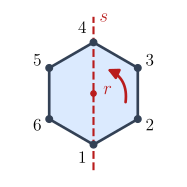
(A) Let. Find . (B) Use the orbit–stabilizer theorem to find the number of colorings in, and then list them. (C) For each of, , , and , find for the action on the black-and-white colorings, and explain your count using the cycles of . (D) Let. Find . Use the orbit–stabilizer theorem to find the number of colorings in , and then list them.
A symmetry fixes a black-and-white coloring exactly when it sends the set of
black corners to itself. A coloring is fixed by
4. (Orbit–stabilizer in other settings) #
(A) The rotations of a regular tetrahedron act on itsfaces, and every face can be carried to every other face. Find the number of rotations that carry a given face onto itself, and use the orbit–stabilizer theorem to find the number of rotations of the tetrahedron. (B) Therotations of a cube act on its edges, and every edge can be carried to every other edge. Use the orbit–stabilizer theorem to find the number of rotations that carry a given edge onto itself, and describe them. (C) A triangular prism has two equilateral triangles as ends and three squares as sides. Its rotations act on itsvertices, and every vertex can be carried to every other vertex. Show that only the identity fixes a vertex, and find the number of rotations. (D) acts on the six -element subsets of the corners of the square by . Find the orbits of this action. Find and , and check the orbit–stabilizer theorem for both.