Midterm 3 Practice Worksheet 1: Groups and Permutations#
This worksheet is optional practice for Midterm 3. It is not collected or graded. Work on paper, as you would on the exam, and write the method that justifies each answer. Then compare with the solutions.
This worksheet covers groups, subgroups, cyclic groups, and permutations: the
true-or-false facts about groups and the computations with permutations and
with
1. (True or false) #
Decide whether each statement is always true, and give a one-line reason or a counterexample. On the exam, true-or-false questions need no justification, but finding the reason is the best way to check your answer.
(A) The group, with addition modulo , is cyclic. (B) The symmetric groupis cyclic. (C) The setis a subgroup of . (D) In, . (E) A group withelements can have a subgroup with elements. (F) If an elementof a group has order , then . (G) The permutationin has order .
2. (Groups and subgroups) #
(A) In, with addition modulo , list the elements of , , and . Is cyclic? List all of its generators. (B) Decide which of the following subsets are subgroups. For each subset that is not a subgroup, give a sum that leaves the subset.(C) In, compute and . Is commutative? Find the order of each of the elements of , and decide whether is cyclic. (D) A grouphas elements. Which of the numbers , , , can be the number of elements of a subgroup of ? Can contain an element of order ? An element of order ? (E) An elementof a group has order . Which of , , , are equal to ? Write and in the form with . (F) Find the order of each permutation:, , , and .
A finite subset of a group is a subgroup exactly when it is closed under the operation. By Lagrange’s theorem, the number of elements of a subgroup, and the order of an element, divide the number of elements of the group. The order of a permutation written with disjoint cycles is the least common multiple of the cycle lengths; when cycles overlap, compute the product first.
3. (Working with a permutation) #
Let
(A) Writein cycle notation. Give the cycle type of and . (B) Find the order ofand write in cycle notation. (C) Compute the composition(first , then ) and write it in cycle notation. Give its cycle type. (D) Computeand compare it with . (E) The permutationin is written with its fixed points omitted. Give the cycle type of , , and the order of .
4. (Another permutation) #
Let
(A) Writein cycle notation. Give the cycle type of and . (B) Find the order ofand write in cycle notation. (C) Compute the composition(first , then ) and write it in cycle notation.
5. (Cyclic subgroups of #
(A) In, with addition modulo , list the elements of the cyclic subgroups and , and give the orders of the elements and . (B) Isa generator of ? Is ? Explain, and list all generators of . (C) In, list the elements of . Is a generator of ? List all generators of . (D) In, list the elements of the cyclic subgroup and give the order of the element . Is a generator of ? Explain.
In
6. (Symmetries of the regular pentagon) #
Label the corners of a regular pentagon
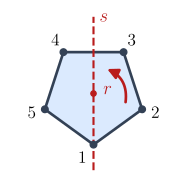
(A) Write, , , , and as permutations of the corners in cycle notation. (B) Computeand , and check that they are equal. Is ? (C) Find the order andof every element of . Is cyclic?