Midterm 3 Practice Worksheet 2: Solutions#
These are the solutions to
Practice Worksheet 2. The
write-ups model the amount of explanation expected on the exam. A symmetry
True or false#
(A) True.
(B) False.
(C) False. By the orbit–stabilizer theorem,
(D) True. For example,
(E) True. Write
(F) False. By (E), two orbits with a common element
(G) True. The orbit sizes divide
(H) True.
(I) False.
(J) True.
Colorings of the square#
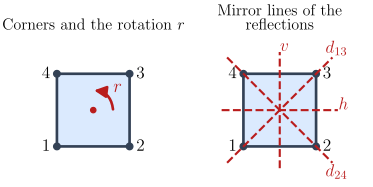
(A) For each B, B, B, W) to corners BBWB. All eight results:
(B) In the same way:
Without computing: a symmetry fixing
(C) A coloring is fixed by
has cycles: corners agree and corners agree. , colorings. has cycle: all corners agree. , colorings. has cycles: corners agree, and corners and are free. colorings. The fixed corners and are cycles too; forgetting them would give the wrong count .
(D) The color at corner WRBR. All eight results:
(E) As in (C),
Colorings of the hexagon#
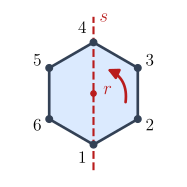
(A) A symmetry fixes
rotations:
fixes everything; exchanges ; , , , send to , , , , none of which is white. reflections:
exchanges , and fixes and ; the others send elsewhere ( to , to , to , to ).
So
(B) By the orbit–stabilizer theorem,
(C)
: cycles, so fixed colorings (the odd corners agree and the even corners agree). : cycles, so . : cycles, including the fixed corners and , so . : cycles, so .
(D) A symmetry fixes
Orbit–stabilizer in other settings#
(A) A rotation that carries a face onto itself keeps the center of
that face and the center of the tetrahedron in place, so it turns the
tetrahedron about the line through them, which also passes through the opposite
vertex. The rotations about this axis are by
(B) The orbit of an edge has
(C) Each vertex lies on exactly one of the two triangles. A half turn
about a horizontal axis exchanges the two triangles, so it moves every vertex.
The other rotations turn the prism about the vertical axis through the centers
of the triangles; the rotations by
(D) Symmetries preserve adjacency, so they send sides to sides and
diagonals to diagonals; the rotations carry any side to any other side, and any
diagonal to the other one. So there are two orbits: the