Homework 8#
Due: Thursday, November 5, 2026 23:59
Submit: Gradescope, through
Blackboard’s assignment area.
Please write your homework by hand. Start each exercise on a new page, scan your work to a legible PDF, and clearly mark the pages associated with every exercise. This assignment comes with tables and blank pictures for you to fill in. You may print them and write on them, or copy them by hand.
All four exercises are about one solid, so they build on each other: the table you complete in Exercise 1 is the main tool for the other three.
The pentagonal bipyramid#
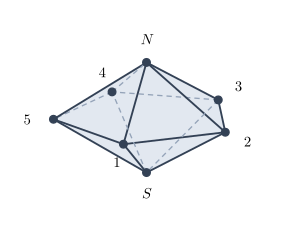
Glue two pentagonal pyramids together along their pentagonal bases. If every
face is an equilateral triangle, the result is the solid shown below, called
the pentagonal bipyramid. It has
The top vertex is
and the bottom vertex is . The five vertices around the middle, on the equator, are
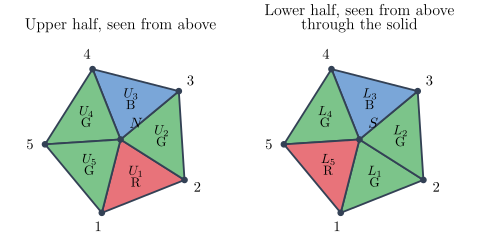
, in counterclockwise order when seen from above. The upper face with vertices
is called , and the lower face with vertices is called . Here means , so has vertices .
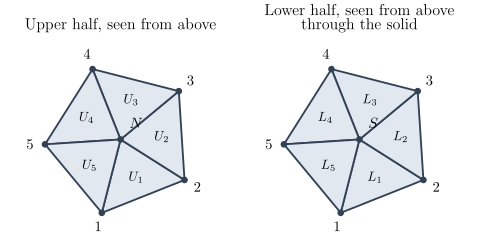
Let
Naming rigid motions. We will see in Exercise 1 that a rigid motion
Moving colorings. As in the lecture notes, a rigid motion
1. (How many rigid motions are there?) #
Points: 10
(A) 2 points. How many edges meet at? At ? At each equatorial vertex? A rigid motion sends each vertex to a vertex with the same number of edges. Use this to explain why every rigid motion has or . (B) 2 points. Take as known that a rigid motion is determined by the two verticesand . (Once you know where goes and where goes, the vertex must go to the next vertex around the equator, in the direction fixed by whether the solid is right side up or upside down, and so on.) Explain why there are at most rigid motions. (C) 3 points. Now show that there are exactlyrigid motions by showing that every name and is a real rigid motion. For
: describe a rigid motion that turns the solid about the vertical line through and and sends to . What is its angle? For
: take the line through vertex and the midpoint of the edge from to , and turn the solid by about it. Explain why this swaps and , keeps in place, and carries the solid onto itself. For
: explain why doing first and then is a rigid motion that sends to and to .
(D) 3 points. Complete the following table, which records where each rigid motion sends each vertex. Three rows are started for you. Then check your count with the orbit–stabilizer theorem: what is the orbit of the vertex, and which rigid motions are in ?
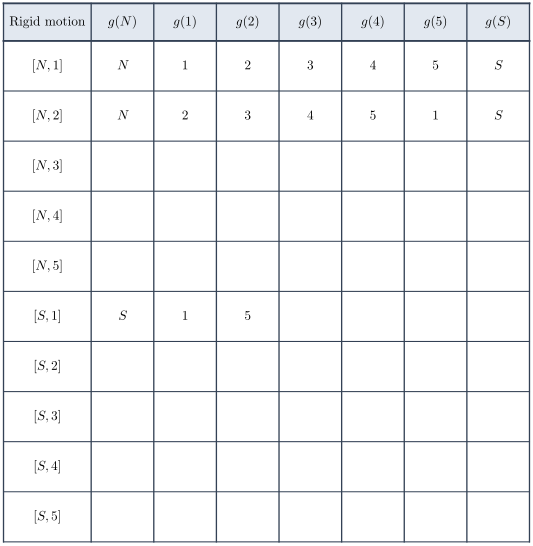
For the rows
2. (An orbit and a stabilizer) #
Points: 10
We use three colors: red (
The vertex coloring
colors and red, and blue, and green. The face coloring
colors and red, and blue, and the other six faces green.
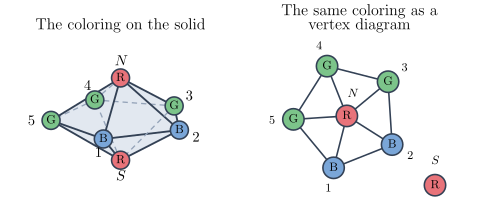
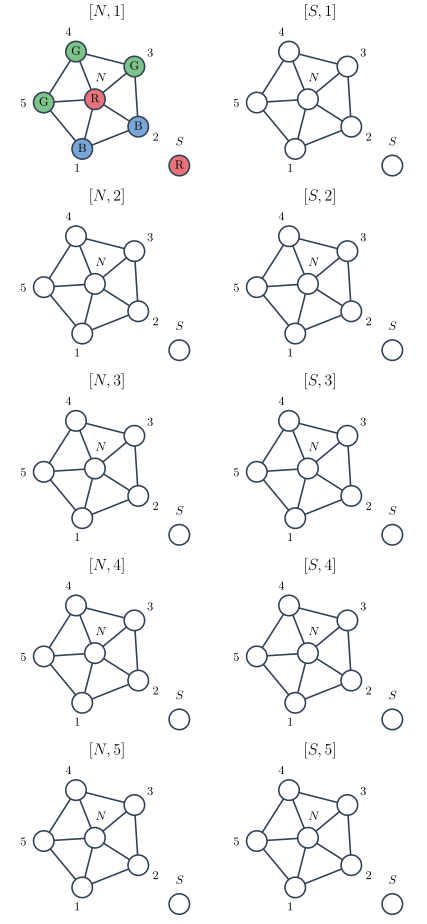
(A) 5 points. The orbit of. (i) In the blank diagrams at the end of this exercise, drawfor each of the rigid motions , by writing a color letter in every circle. Use your table from Exercise 1: the color at moves to . The diagram for is done for you. (ii) How many different colorings appear among yourdiagrams? These colorings form the orbit . Describe the orbit in words. (iii) Which rigid motionssatisfy ? These form the stabilizer . Check that .
(B) 5 points. The stabilizer of. Find by following these steps. (i) If, then must send the red face to a red face. Explain why this means or . (ii) The faceis the face whose vertices are , , and . Use your table from Exercise 1 to find every rigid motion with and every rigid motion with . (You should find exactly one of each.) (iii) For each rigid motion you found in (ii), check whether it also sends the blue faces to blue faces and the green faces to green faces. Write downusing the names , and describe each of its elements geometrically. (iv) Use the orbit–stabilizer theorem to find how many different face colorings are in the orbit, without listing them.
3. (Classifying the rigid motions) #
Points: 10
In this exercise you sort the
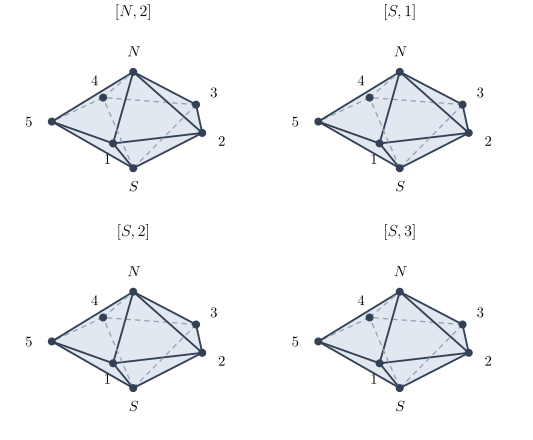
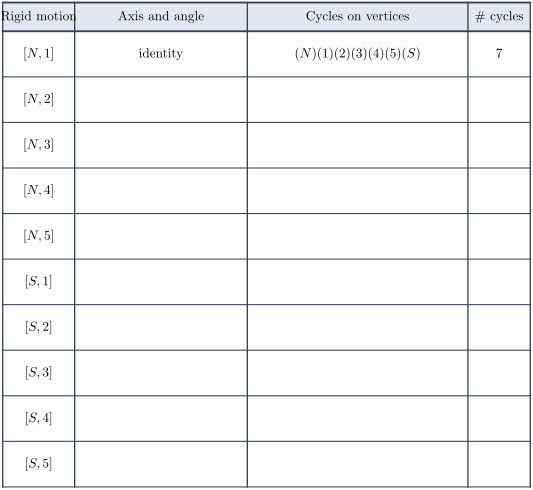
(A) 3 points. On the blank solids below, draw the axis of each of the rigid motions, , , and , and give the angle of each rigid motion. For the half-turns, say which vertex lies on the axis and which edge the axis passes through the midpoint of. (B) 4 points. Complete the table of cycles on vertices. In the column “Axis and angle” write, for example, “vertical,” or “through and the midpoint of – , .” In the column “Cycles on vertices” write the permutation of the vertices in cycle notation, including cycles of length , and in the last column write the number of cycles. (C) 3 points. Complete the table of cycles on faces: the permutation of thefaces in cycle notation, including cycles of length , and the number of cycles. Then answer: how many rigid motions are there of each of the following three types, and do all rigid motions of the same type have the same numbers of cycles? the identity;
vertical turns: turns about the vertical axis through
and by a nonzero angle; half-turns about an axis through an equatorial vertex.
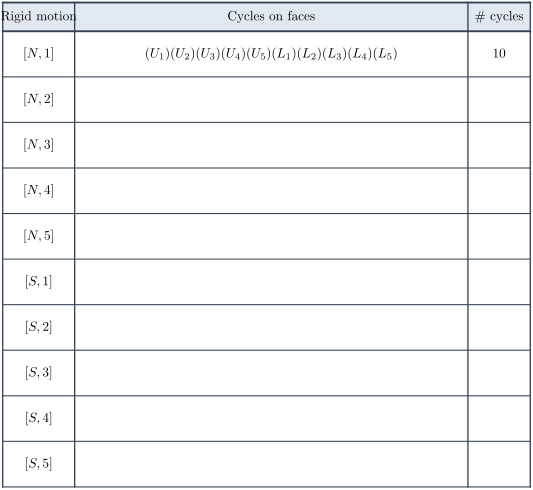
For the faces, use the same idea as in Exercise 2(B):
4. (Counting colorings up to rigid motion) #
Points: 10
Two colorings are the same up to rigid motion if some rigid motion carries one
to the other, that is, if they lie in the same orbit. We count the orbits with
Burnside’s lemma:
(A) 3 points. Vertex colorings fixed by a rigid motion.Explain why a vertex coloring
satisfies exactly when all five equatorial vertices have the same color. How many such colorings are there? (The colors of and are free.) Which vertices must have equal colors in a coloring fixed by
? How many such colorings are there? Explain how each answer is
, using your table from Exercise 3.
(B) 2 points. Complete the Burnside table for vertex colorings. Rigid motions of the same type fix the same number of colorings, so each type contributes (how many)(fixed colorings). Add the last column, and divide by to find the number of vertex colorings with colors up to rigid motion. (C) 3 points. Face colorings fixed by a rigid motion. Repeat (A) for colorings of thefaces: describe the face colorings fixed by and those fixed by (which faces must have equal colors?), and count them. (D) 2 points. Complete the Burnside table for face colorings, and find the number of face colorings withcolors up to rigid motion.
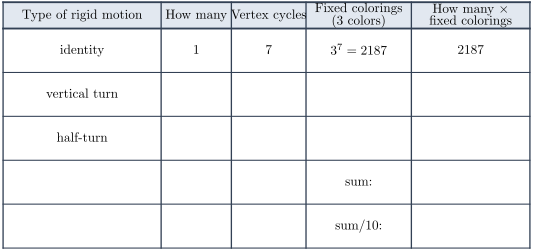
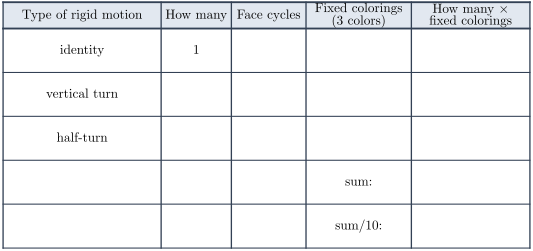
Check your work: each final answer must be a whole number. As a second check,
redo the computation with