Homework 4#
Due: Thursday, September 24, 2026 23:59
Submit: Gradescope, through
Blackboard’s assignment area.
Please write your homework by hand. Start each exercise on a new page, scan your work to a legible PDF, and clearly mark the pages associated with every exercise.
1. (A board with separate components) #
Points: 10
The diagram shows two allowed boards,
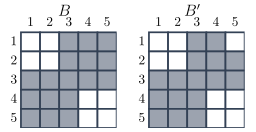
(A) 2 points. Find the rook polynomial of each of the two-by- components of . (B) 4 points. Use the disjoint-board product rule to find. (C) 4 points. Find. Use the select–not-select rule to discuss the square .
2. (Rook numbers by inclusion–exclusion) #
Points: 16
Let
In this exercise we will use the principle of inclusion exclusion to count rook numbers. This is efficient because there are very few forbidden squares.
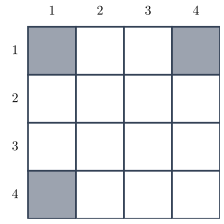
Let
The rook number
Write the following three conditions on a placement in
(A) 4 points. Findfor each . (B) 7 points. For each, compute the number of placements in each of and in each pairwise intersection Also determine . Explain which intersections are empty and why. Be careful, whether intersections are empty or not may depend on
. (C) 5 points. Apply inclusion–exclusion to findfor each .
3. (Separate variables before recording value) #
Points: 14
There are 5 2-cent coins on the table. There are also as many 3-cent and 7-cent coins as you need. How many selections of these coins have total value 30 cents?
Suppose
(A) 5 points. Write a generating function for the possible numbers of 2-cent coins using. Do the same for the possible numbers of 3-cent and 7-cent coins using and , respectively. Truncate each series at the highest exponent that could matter for a total of 30 cents. (B) 3 points. Replace, , and with appropriate powers of to obtain generating functions that record total value. (C) 6 points. Use the product of these generating functions to find the number of selections. Identify the coefficient whose value is the answer. You may use https://sagecell.sagemath.org/ to expand the product, but show your generating-function setup. For example, the code to computeis var('x') f = (1 + x + x^2 + x^3) * (1 + x^2 + x^4) show( f.expand() )