4. Binomial expansions, Pascal paths, and Catalan numbers#
The preceding notes developed combinations, multinomial coefficients, lattice
paths, and stars and bars as counting models. A new problem rarely announces
which model it needs, so we begin by comparing four similar-looking choices
whose outcomes are very different.
Then, we will see how the coefficients appear in many surprising circumstances:
in expansions of polynomials, in Pascal’s triangle, and recursive
lattice-path counts.
Finally, imposing restrictions on those paths leads to hard counting problem. A famous one is that of
the Catalan numbers and the reflection principle that counts them.
These numbers also appear in counting ways to parenthesise expressions.
After studying these notes, you will be able to do the following.
Decide which kind of choice describes a problem by determining whether
order matters and whether repetition is allowed.
Model combinations with repetition as multiplicity vectors and count
them.
Explain the relationship among stars and bars, cumulative totals, weakly
increasing sequences, and strictly increasing sequences.
Translate lower bounds for integer solutions so that stars and bars applies.
Use the binomial and multinomial theorems to extract coefficients from
powers of polynomials.
Verify Pascal’s recurrence algebraically and prove it combinatorially.
Compute lattice-path counts recursively and count paths that pass through
or avoid a specified point.
Use tail reflection to derive the Catalan-number formula and relate
Catalan paths to balanced-parenthesis strings.
A bakery sells ten types of doughnuts. A manager wants to buy six doughnuts
for six employees. Four different purchasing scenarios will help us compare
the available models.
Which standard kind of choice describes each scenario?
The manager decides which type of doughnut to buy for each employee and
may choose the same type for several employees.
The manager again chooses one type for each employee, but decides not to
buy the same type twice.
The manager selects six different types and lets the employees decide
who receives which one.
The manager buys six doughnuts to bring to the employees. Several
doughnuts may have the same type, and the manager does not assign them to
particular employees.
The important question is not only whether the manager purchases six
doughnuts. We must ask what information one outcome retains.
In the first scenario, the employees play the role of six labeled
positions. For each employee, the manager chooses one of ten types and may
repeat the same type. An outcome is a length- string of
doughnut types, or equivalently a function from the employees to the types.
The number of choices is .
The employees are still labeled, so assigning glazed to Alice and
chocolate to Bob is different from assigning chocolate to Alice and glazed to
Bob. Repetition is now forbidden. This is a -permutation of the ten types,
and the number of choices is .
The manager selects the six types before any employee receives one.
Order and employee assignments are not part of the purchase, and the manager
repeats no type.
This is an ordinary combination, with
possible selections.
Order and employee assignments are again irrelevant, but repetition is
allowed. The manager might buy six glazed doughnuts, six different types, or
anything in between. This is a combination with repetition, and the
number of choices is .
The four scenarios occupy the four rows of the familiar choice table:
In this table, is the number of available types and is the number of
objects selected. The bakery story shows why the wording of the problem is not
enough by itself: the mathematical model depends on what counts as a different
outcome.
4.2 Combinations with repetition and cumulative totals#
Let us return to the fourth bakery scenario. If is the number of doughnuts of
type , then a nonnegative integer solution describes a purchase:
More generally, selecting objects from types with repetition is the
same problem as finding the nonnegative integer solutions of
The stars-and-bars construction places stars in a row and uses
separators to divide them among the types. There are positions
altogether. Choosing the separator positions gives
solutions. Choosing the star positions instead gives the equal expression
Thus the six-doughnut purchase in the fourth scenario can be made in
ways.
Can we explain this count using another combinatorial encoding? Yes. We can record
the separator positions as cumulative totals.
4.2.2 Cumulative totals and weakly increasing sequences#
A sequence is weakly increasing if each term is at least the preceding
term:
It is strictly increasing if each inequality is strict:
Repeated values are allowed in a weakly increasing sequence but not in a
strictly increasing sequence.
For a nonnegative solution of , we define
Since every is nonnegative,
The number records how many stars appear before separator . Two
separators may have the same number of stars before them, which is why the
sequence is only weakly increasing. The final total is forced, so we
omit it from the encoding.
This construction is reversible. If numbers satisfy
, then we recover
Thus solutions of are in bijection with weakly increasing
sequences of length selected from
Such a sequence is a choice with repetition of elements from
possible values. Applying the combination-with-repetition formula with these
roles exchanged gives
exactly as in the separator count.
Example4.2(Encoding the separators by cumulative totals)#
The solution of
gives
In a stars-and-bars string, the three separators occur after ,, and
stars. Conversely, the differences
recover .
4.2.3 An alternative proof of the combinations with repetitions formula#
We already know that the number of nonnegative integer solutions of
is . We obtained this answer by arranging stars and
separators. Let us now obtain the same answer in a different way, using an
ordinary combination.
An ordinary combination is a choice of distinct elements from a set. Thus our
plan is to encode each solution as a subset. The cumulative totals from the
preceding section almost do this, but they are only weakly increasing: two
consecutive totals can be equal when some is zero. To make the totals
strictly increasing, we first make every part positive.
Theorem4.3(Combinations with repetition, revisited)#
The number of nonnegative integer solutions of
is
Equivalently, this is the number of ways to select objects from types
when repetition is allowed.
We start with a nonnegative solution and define
We have added one to each of the variables, so
More importantly, every is positive. This guarantees that the partial
sums increase at every step.
Next, we record the first partial sums:
Since each is at least , these numbers satisfy
The final inequality holds because at least must remain for . We have
therefore obtained an ordinary -element subset
We must check that this encoding does not lose any information. For any
-element subset of , we write its elements in
increasing order:
We recover the positive integers by taking consecutive
differences:
Every one of these numbers is positive. Moreover, their sum telescopes:
Finally, we define . The resulting are nonnegative, and their
sum is , so they form a solution of the original equation.
The two constructions undo one another. We have therefore established a
bijection between the solutions of and the
-element subsets of . The number of such subsets is
Example4.4(Following one solution through the bijection)#
Let us follow the earlier solution
of . Adding to each entry gives
whose sum is . The first three partial sums are
Thus the solution corresponds to the three-element subset
of .
Starting with , consecutive differences recover
which gives . Subtracting from each entry returns the original
solution .
Remark4.5(From weakly increasing to strictly increasing)#
There is a direct connection between this proof and the weakly increasing
sequence from the preceding section. We had
Since , the new partial sums satisfy
Thus we turn a weakly increasing sequence into a strictly increasing one by
adding to its first term, to its second term, and so on:
Subtracting from the th term reverses the transformation. Therefore
is equivalent to
Stars and bars applies directly when every variable may be any nonnegative
integer. If a variable must instead satisfy , reserve its
required amount first. The part still available for distribution is
then counted with nonnegative variables.
We set . Then , and the original equation becomes
The substitution is reversible: from a solution in the , recover
. Stars and bars applied to the transformed equation gives the
formula.
Solution: We define
The new variables are nonnegative and satisfy
Therefore the number of solutions is
Warning(Lower bounds and upper bounds behave differently)#
The method we saw allows us to map an integer solution problem with a lower bound (for example ) to a problem
of counting non-negative integer solutions. This method does not work if we have upper bound conditions, for example .
We can still solve the problem when there is an upper bound condition on only one variable, by using the subtraction principle.
However, with several upper bounds, such as and
will require us to use the
inclusion–exclusion principle.
If the variables have lower bounds , we subtract the
lower bounds first. The remaining total is .
Cumulative totals encode a solution as a weakly increasing sequence.
Adding to its th term converts it into a strictly increasing sequence,
which is the same as an ordinary subset.
Let us consider the product
We obtain every raw term in its expansion by choosing either or from
each factor. To obtain , exactly of the factors must contribute
; all other factors contribute . The coefficient is therefore the number
of ways to choose those factors.
Label the factors by their positions. The subset of positions from which
we choose determines a term. If that subset has size , the resulting
term is . There are such subsets. Grouping the raw terms
by gives the displayed expansion.
For example, row of the binomial coefficients gives
The same reasoning works when the two terms have numerical weights.
Solution: To obtain , we choose from exactly four of the
seven factors and choose from the remaining three. The coefficient is
The binomial coefficient chooses the contributing factors; the powers
and record the numerical contribution from those choices.
Solution: The outside factor already contributes , so we need
from . We choose from six factors. The coefficient is
Two useful identities follow immediately from the binomial theorem. Setting
gives
which also counts all subsets of an -element set by their sizes. For ,
setting and gives
Equivalently, the sum of the even-indexed entries in row equals the sum of
the odd-indexed entries.
We choose one term from each of the labeled factors. A raw term equals
exactly when the resulting choice string contains
copies of for every . The number of such strings is
Grouping equal raw terms proves the formula.
Example4.12(A multinomial coefficient with weights)#
What is the coefficient of in ?
Solution: The exponents sum to , so the requested term can occur.
We choose the two factors contributing , the three contributing , and the
one contributing . The coefficient is
Before we compute a multinomial coefficient, we check the total degree. For
example, the coefficient of in is zero because the
requested exponents sum to , while every term in the expansion has total
degree .
The factorial formula is not the only way to compute binomial coefficients.
A local counting argument relates each interior entry to two entries in the
preceding row.
For an -element set with a distinguished element , we partition
the -element subsets of into two classes.
If a subset does not contain , we choose all elements from the remaining
elements, giving possibilities. If it contains , we choose
its other elements from the remaining , giving
possibilities. The two classes are disjoint and exhaustive, so the sum rule gives
the recurrence.
Starting with the boundary entries and using the recurrence produces
Pascal’s triangle:
We obtain entry by adding the two entries immediately above it. The
symmetry is visible in the triangle and corresponds to
choosing the included elements or, equivalently, the omitted elements.
For nonnegative integers and , we write for the number of
northeast lattice paths from to .
If , a path reaches either from by a right step or
from by an up step. These cases are disjoint, so
Along the axes there is only one path, so . These are the
same recurrence and boundary data as Pascal’s triangle. Therefore
in agreement with the step-string argument from the preceding notes.
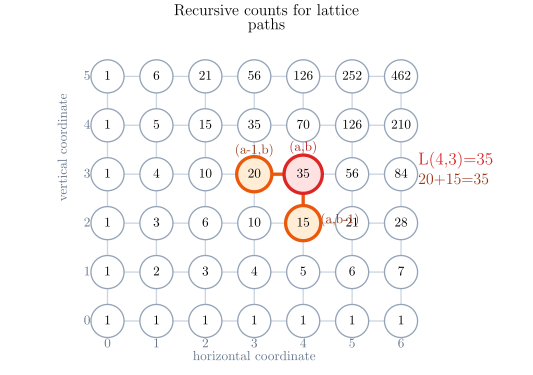
We can use the recurrence to fill an entire grid. We begin with along the
coordinate axes. At every interior vertex, we add the labels at the vertex to
its left and the vertex below it.
Figure 4.1 shows this computation near the point
.
Figure4.1: A recursive table of northeast-path counts. The highlighted point
can be reached from in ways and from in
ways, so its label is .#
This table is a rotated portion of Pascal’s triangle. It also suggests a way to
handle forbidden vertices when no direct formula is available: we assign a
forbidden vertex the value zero, then continue filling the table by the same
left-plus-below rule.
For and , a path from to
that passes through decomposes uniquely into a path from to
followed by a path from to . The product rule gives
The total number of paths to is , so the number avoiding
is
A path from to that passes through consists of a
path with four right and seven up steps, followed by a path with six right and
three up steps. Thus the number passing through the point is
There are paths altogether, so the number avoiding
is
The product formula assumes that is coordinatewise between the start
and endpoint. A northeast path from to cannot pass through a
point with a negative coordinate, an -coordinate greater than , or a
-coordinate greater than .
There are northeast paths from to . We now impose a
global restriction: at every point of the path, require
In other words, the path may touch the diagonal , but it may never go
above it. A path satisfying this restriction is called a Catalan path
or a Dyck path.
The th Catalan number is the number of northeast lattice
paths from to that never go above the line .
We include the empty path, so .
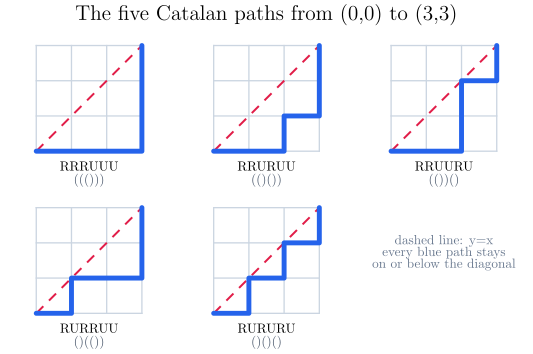
For ,Figure 4.2 displays all five paths that obey
the diagonal restriction.
Figure4.2: The five Catalan paths for . The corresponding step strings and
balanced-parenthesis strings are displayed below the paths.#
To count the valid paths, we subtract the paths that cross the diagonal. The
reflection principle gives a bijective count of those bad paths.
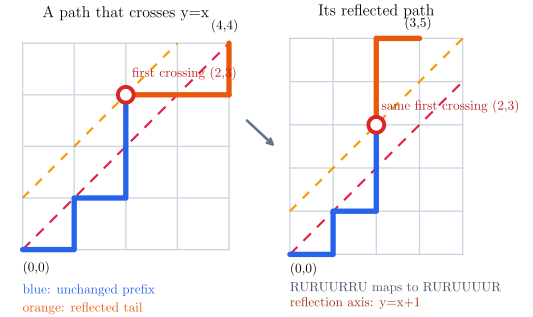
Figure 4.3 previews the transformation: reflection leaves
the path unchanged until its first crossing and reflects the remaining tail.
Figure4.3: Reflecting the tail after the first crossing changes a bad path to
into a path to . The construction is reversible.#Theorem4.18(Catalan formula)#
For , the one path is empty, and both displayed expressions equal .
Now assume . A bad path has a first point at which it reaches the line
. We keep the path unchanged up to that point and reflect the
tail—the portion from the first crossing to the endpoint—across the
line . The crossing point lies on the reflecting line and therefore
stays fixed. On the tail, reflection exchanges right steps and up steps.
Reflection across sends a point to . In particular,
it sends the original endpoint to . The resulting path
therefore goes from to .
This map is reversible. Any northeast path from to must
reach the line . We keep its prefix through the first point on that line
and reflect its tail across the line. This produces a bad path to , and
reflecting the same tail again recovers the original path. Thus bad paths to
are in bijection with all paths to .
There are
such paths. Subtracting them from all paths gives the first formula.
Finally,
so the difference is .
The first Catalan numbers are
For , the five Catalan step strings are
We replace every right step by a left parenthesis and every up step by
a right parenthesis. A path ends at exactly when the string contains
parentheses of each kind. The condition says that every initial
segment contains at least as many left parentheses as right parentheses. This
is exactly the condition for a balanced-parenthesis string.
Hence also counts balanced strings of pairs of parentheses. For
example, the five paths above correspond to
Conversely, replacing each left parenthesis by and each right parenthesis
by recovers a unique Catalan path. The two replacements undo one another,
so this correspondence is a bijection.
This is an important combinatorial lesson: a named sequence is usually useful
because it counts many families of objects, not only because it has a closed
formula.
A first-return decomposition of a nonempty Catalan path gives
A later note on combinatorial recurrences will develop this nonlinear
recurrence. For now, the reflection argument supplies the closed formula.
How many northeast paths from to never go above ?
How many go above the diagonal at least once? Which count comes from
subtraction, and which comes from the reflection bijection?
The main formulas in these notes arise from a small number of reversible
encodings and counting rules:
In each case, the formula becomes easier to remember after identifying the
objects behind it: shifted sequences, translated integer vectors, choices from
labeled factors, subsets split by a distinguished element, concatenated paths,
or reflected paths.
The course resources page links to the books used as
references for these notes. Applied Combinatorics, Sections 2.5–2.7,
covers lattice paths and binomial and multinomial expansions. Counting
Rocks!, Sections 4.1–4.3 and 4.5–4.6, covers Pascal’s recurrence, binomial
identities, and multinomial counting. Discrete Mathematics: An Open
Introduction, Sections 3.1–3.2, presents coefficient and lattice-path
interpretations. Combinatorics Through Guided Discovery, Section 1.3.1,
also discusses Catalan paths and the reflection principle.