An assignment problem may prohibit some person–position pairings. A rook board
keeps those prohibited cells visible while we count only assignments that use
allowed cells. The coefficients of a rook polynomial count legal partial
assignments; the coefficient for all rows counts legal complete assignments.
After studying these notes, you will be able to do the following.
Model allowed assignments by white squares of a board and nonattacking rook placements.
Compute rook numbers and the rook polynomial of a small finite board.
Use a disjoint-board product and a use-or-omit recurrence to compute a rook polynomial.
Use the appropriate rook number to count legal complete assignments.
Count injective assignments when there are more positions than objects.
Let be a finite collection of allowed squares in a rectangular grid. For an
integer , the th rook number is the number of
ways to place nonattacking rooks on squares of . The placement with no
rooks is allowed, so .
A board with rows and columns has no nonattacking placement of more
than rooks. The full boards give a first set of rook numbers
that can be counted without examining individual placements.
How many ways are there to place four nonattacking rooks on a full -by-
board? Explain why these placements are in bijection with the permutations of
.
Solution: A four-rook placement uses four distinct rows and four
distinct columns. Since the board has exactly four rows and four columns, it
has one rook in every row and one rook in every column. Choose the column for
the rook in row , then row , then row , and finally row . There
are respectively ,,, and choices, so
The word “equivalently” describes the same collection of placements using
functions rather than board squares. Let be the set of four-rook
placements, and let be the set of bijective functions from
to itself. For a placement , define
There is exactly one rook in row , so is defined. Distinct rows
have rooks in distinct columns, so different inputs have different outputs;
because all four columns are used, is bijective. Conversely, for
, place a rook at for each . The function assigns
one column to each row, and its bijectivity makes those columns distinct, so
the rooks are nonattacking. These two instructions undo one another. The left
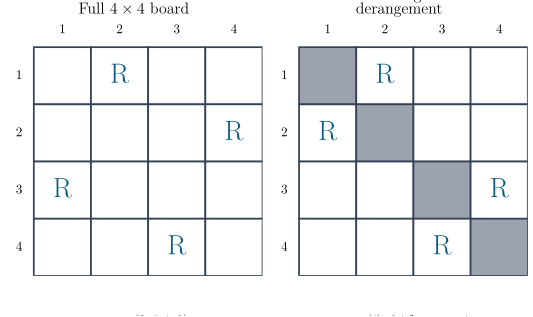
panel of Figure 6.1, for example, records
the permutation .
Remove the four squares on the main diagonal of a -by- board. How many
ways are there to place four nonattacking rooks on the remaining squares?
Solution: Under the bijection in
Example 6.2, the diagonal square records
the equation . Thus a placement avoiding every diagonal square
corresponds to a permutation with no fixed points: a derangement.
Let be the set of permutations with . If specified
positions are fixed, the other positions may be permuted in
ways. Inclusion–exclusion gives the desired rook number as
Therefore the board without its main diagonal has four-rook
placements. The right panel of Figure 6.1
shows one of them.
Figure6.1: A full four-by-four board and the board obtained by removing its main diagonal. A full placement represents a permutation; a full placement avoiding the grey diagonal squares represents a derangement.#Example6.4(Three rooks on a full -by- board)#
How many ways are there to place three nonattacking rooks on a full -by-
board?
Solution: A placement has three occupied rows and three occupied
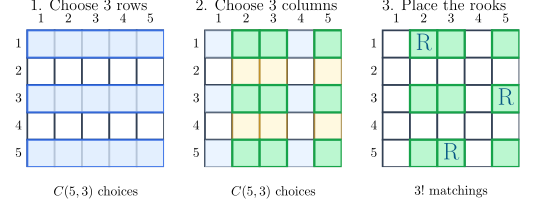
columns. First choose its occupied rows, in ways. Next choose its
occupied columns, also in ways. These choices leave a -by-
intersection grid, as shown in the first two panels of
Figure 6.2.
Each selected row must be paired with a different selected column. Order the
three selected rows from top to bottom. The rook in the first selected row has
three selected columns available, the next has two, and the final rook has one.
Thus the selected intersection grid has nonattacking placements, as the
third panel shows. The product rule gives
Every placement determines its occupied rows, its occupied columns, and the
matching between them. Conversely, those three choices place the rooks. Hence
each three-rook placement is counted exactly once.
Figure6.2: Counting three nonattacking rooks on a full five-by-five board. Select three rows, select three columns, and then choose a bijection between the selected rows and columns.#
Suppose that three students must be assigned, one each, to three presentation
slots. Student receives slot , where is a permutation of
. The four pairings in the following display are unavailable:
For example, says that student cannot receive slot .
Rows of the grid represent students, and columns represent slots. Grey cells
are forbidden. The allowed board consists of the white cells:
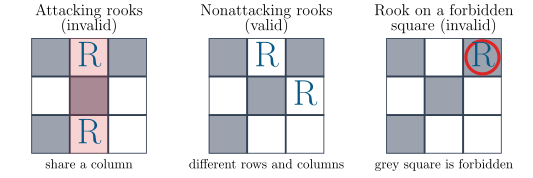
Rooks are placed only on squares of , never on grey cells. A rook at
records the legal assignment . Two rooks are
nonattacking when they lie in different rows and different columns;
then their two assignments can occur together.
Figure6.3: The same forbidden-position board in all three panels. Two rooks in one column attack and give an invalid placement. Two rooks in different rows and columns give a valid placement. A rook on a grey forbidden square is invalid.#
Rook numbers are computed from the allowed board , not from the whole
assignment grid. Thus every rook counted by lies on a white square. A
placement of nonattacking rooks records legal assignments made at
once. For example, the middle panel of Figure 6.3 records
the assignments and .
Let be the allowed board in Figure 6.3. We compute
every rook number directly. Every square named in the following list belongs to
.
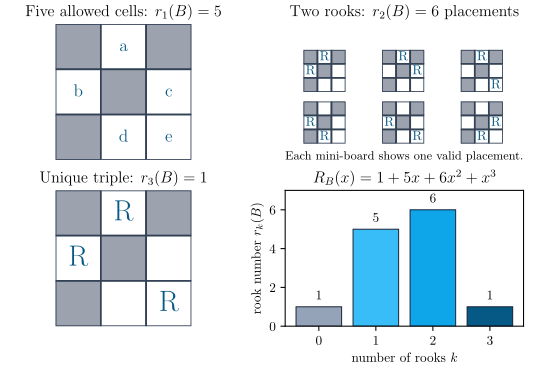
The count is easier to check when we keep the board, the legal pairs, and the
unique three-rook placement in view at the same time. The figure records those
objects before the list below explains why each coefficient has its value.
Figure6.4: A direct count of the rook numbers for . The five allowed cells give ; six unordered pairs use different rows and columns; exactly one three-rook placement is possible; and these values become the coefficients of .#
There is one zero-rook placement, so .
There are five allowed squares, so .
For two rooks, list the unordered pairs of allowed squares that use
different rows and columns:
Thus . A pair such as is not counted because its
two rooks would share row .
A three-rook placement must use every row and every column. The only
possibility is , so .
No four-rook placement is possible on a board with only three rows. The list
of rook numbers is therefore
Counting placements one number at a time repeats the same work whenever we ask
about three, four, or five rooks on a larger board. A single polynomial stores
all of those counts, with the exponent recording the number of rooks.
The rook polynomial of a finite allowed board is
The coefficient of is the number of legal nonattacking placements of
rooks on .
For the board above, direct enumeration gives
The coefficient of records the six two-assignment legal placements, and
the coefficient of records the one complete legal assignment.
6.5 Computing rook polynomials without listing every placement#
Direct enumeration is reliable for a small board, but it becomes tedious when
there are many possible placements. The product rule and the use-or-omit
recurrence reorganize the count.
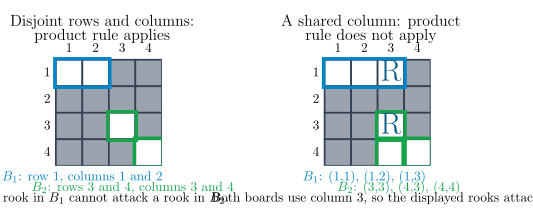
Suppose and use disjoint sets of rows and disjoint sets of
columns. Write for the board formed by taking both sets of
squares. A rook placement on this board splits uniquely into a placement on
and a placement on ; rooks in one component cannot attack rooks in
the other component.
Figure6.5: The product rule requires both row sets and column sets to be disjoint. At left, a rook placement on can be combined with any rook placement on . At right, the two subboards share column , so placing one rook in each can produce an attacking pair.#Theorem6.6(Product rule for disjoint rook boards)#
If and occupy disjoint row sets and disjoint column sets, then
The right panel of Figure 6.5 shows why both
conditions are necessary. Disjoint squares alone are not enough: if two
subboards share a row or a column, a rook placement in one may attack a rook
placement in the other.
To form a placement of rooks on , choose an integer
between and , place rooks on , and place the remaining
rooks on . The decomposition is unique because every square belongs to
one component. Therefore
The coefficient of in is the same sum. Since the
two polynomials have the same coefficient for every , they are equal.
Example6.7(Two separate groups of allowed squares)#
Suppose consists of one allowed square. Suppose consists of two
allowed squares in one common row, and all rows and columns of are
disjoint from those of . Then
because the two squares in attack each other. The combined board has
There are three one-rook placements and two ways to choose one rook from each
component. There is no three-rook placement, as the zero coefficient
also says.
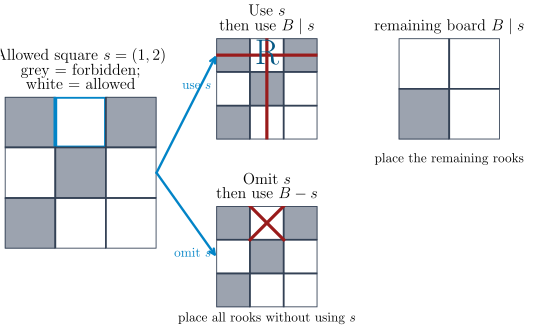
Choose an allowed square of . Every legal rook placement belongs to
exactly one of two classes: it either uses or leaves unused. Both
classes consist entirely of placements on white allowed squares.
Let denote the allowed board obtained by omitting . Let
denote the allowed board remaining after the legal assignment represented by
has been fixed: remove the row and column of , since no remaining rook
may use either one.
Figure6.6: The two classes of legal rook placements at the white allowed square . Using fixes one legal assignment and leaves the smaller allowed board . Omitting leaves the allowed board .#Theorem6.8(Use-or-omit recurrence)#
Placements that leave unused are precisely the placements on .
For a placement that uses , remove the rook at . The remaining rooks
form a placement on , and this operation is reversible by restoring
the rook at . Restoring that rook increases the number of rooks by one, so
the second class contributes .
For the board in Figure 6.3, choose the white allowed
square . If that square is left unused, the remaining allowed board
has four squares. Its two-rook placements are ,, and , so
If a rook is placed at , the remaining legal assignments may use rows
and and columns and . The remaining allowed squares are ,, and , so
The use-or-omit recurrence gives
which agrees with the direct calculation.
The same reasoning works when distinct objects are assigned injectively to
distinct positions, where . A placement of nonattacking rooks
on the allowed board assigns every object to a distinct permitted position.
Keep the four forbidden pairings of the grid, but add a fourth presentation
slot that is available to every student. The allowed board has three additional
squares, one in each row. To find , choose the slot for student .
If student receives slot , the other students can be assigned in four
ways. If student receives slot , they can be assigned in three ways.
Thus
legal injective assignments exist.
The coefficient records the number of legal injective
assignments of rows to distinct columns. In particular, counts
the legal assignments that use every row. The rook polynomial is a finite
first example of a generating function: one algebraic object stores a whole
sequence of related counts.
Ordinary generating functions extend this bookkeeping idea from the finite
sequence to arbitrary sequences indexed by size.